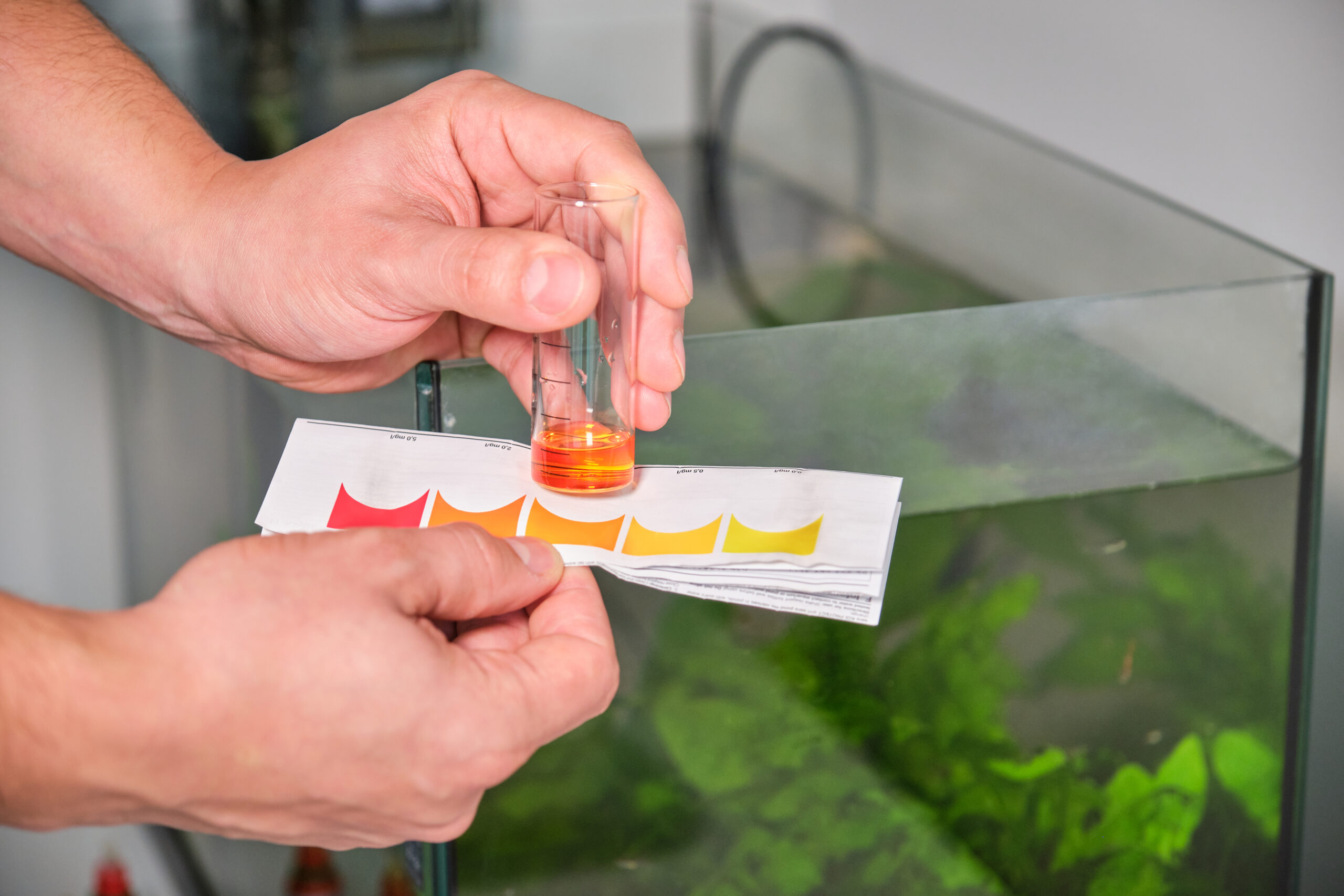
Clean-looking water is not always healthy water. Many dangerous aquarium conditions are colourless and cannot be detected without testing.
Regular aquarium water testing helps fish keepers understand what is happening inside their tanks. It can identify developing problems before livestock begin showing serious signs of stress.
Ammonia
Ammonia is produced by fish waste, uneaten food and decomposing organic material. It is highly toxic to aquatic life and should normally be undetectable in a mature freshwater aquarium.
A detectable ammonia level may indicate an uncycled aquarium, overstocking, excessive feeding, filter damage or the death of an unseen animal.
Nitrite
Beneficial bacteria convert ammonia into nitrite. Nitrite is also toxic and can interfere with a fish’s ability to transport oxygen effectively.
In an established aquarium, nitrite should normally remain undetectable. Any measurable result requires investigation and prompt action.
Nitrate
A second group of bacteria converts nitrite into nitrate. Nitrate is generally less immediately toxic than ammonia or nitrite, but excessive levels can still contribute to stress and algae problems.
Partial water changes, controlled stocking, sensible feeding and healthy plant growth can help manage nitrate.
pH
The pH scale measures whether water is acidic, neutral or alkaline. Different fish species have different preferred ranges.
A stable pH suited to the livestock is usually more important than repeatedly adding chemicals to achieve a particular number. Sudden changes can be stressful and potentially dangerous.
Water Hardness
General hardness relates mainly to dissolved calcium and magnesium, while carbonate hardness affects the water’s ability to resist sudden pH changes.
Understanding the hardness of your water can help you choose suitable fish. Some species naturally prefer soft water, while others thrive in harder conditions.
Temperature
Temperature should be checked regularly with a reliable thermometer. Do not depend entirely on the number displayed on a heater.
Changes in room temperature, equipment faults or incorrect water-change procedures can cause unexpected fluctuations.
How Often Should You Test?
New aquariums should be tested frequently while the nitrogen cycle develops. Established aquariums should also be checked regularly and whenever fish display unusual behaviour.
Testing is especially important after:
- Adding new fish
- A power cut
- A filter failure
- Overfeeding
- Medication
- An unexpected fish death
- Major maintenance
- A sudden algae outbreak
Record the date and results of every test. A written record helps reveal gradual changes that may otherwise be missed.
Never Guess Water Quality
Fish gasping, hiding, clamping their fins or refusing food may be experiencing water-quality problems. Testing should be one of the first actions taken when behaviour changes.
Matthews Aquatic Paradise Ltd offers professional aquarium health checks, fish consultations and ongoing maintenance. Visit www.matthewsaquaticparadise.co.uk for expert aquarium care.